
Effect of Focused Shockwave on the Body
Focused shockwave therapy uses high-energy acoustic waves that penetrate deep into injured tissues. These waves stimulate biological processes associated with tissue repair, including improved blood vessel formation, collagen remodeling, and regulation of inflammation.
A true shockwave travels faster than the speed of sound. The speed of sound through the air is 767 miles per hour, but through water and body tissues it reaches over 3350 miles per hour. That high speed sound wave creates a pressure spike in the tissue of up to 14,500 PSI in less than 1 microsecond. Due to the high pressure and speed of the wave, a focused shockwave can reach up to 4.7 inches deep into the body.
Biological Effects of Shockwave Therapy
Stimulates angiogenesis (new blood vessel formation)
Promotes collagen synthesis and tendon remodeling
Modulates inflammation
Reduces pain signaling
Enhances local circulation and cellular metabolism
Activates tissue repair pathways and growth factors
Conditions with Strong Research Support
Plantar fasciopathy
Achilles tendinopathy
Lateral or medial epicondylopathy (tennis elbow, golfers elbow)
Patellar tendinopathy
Calcific rotator cuff tendinopathy
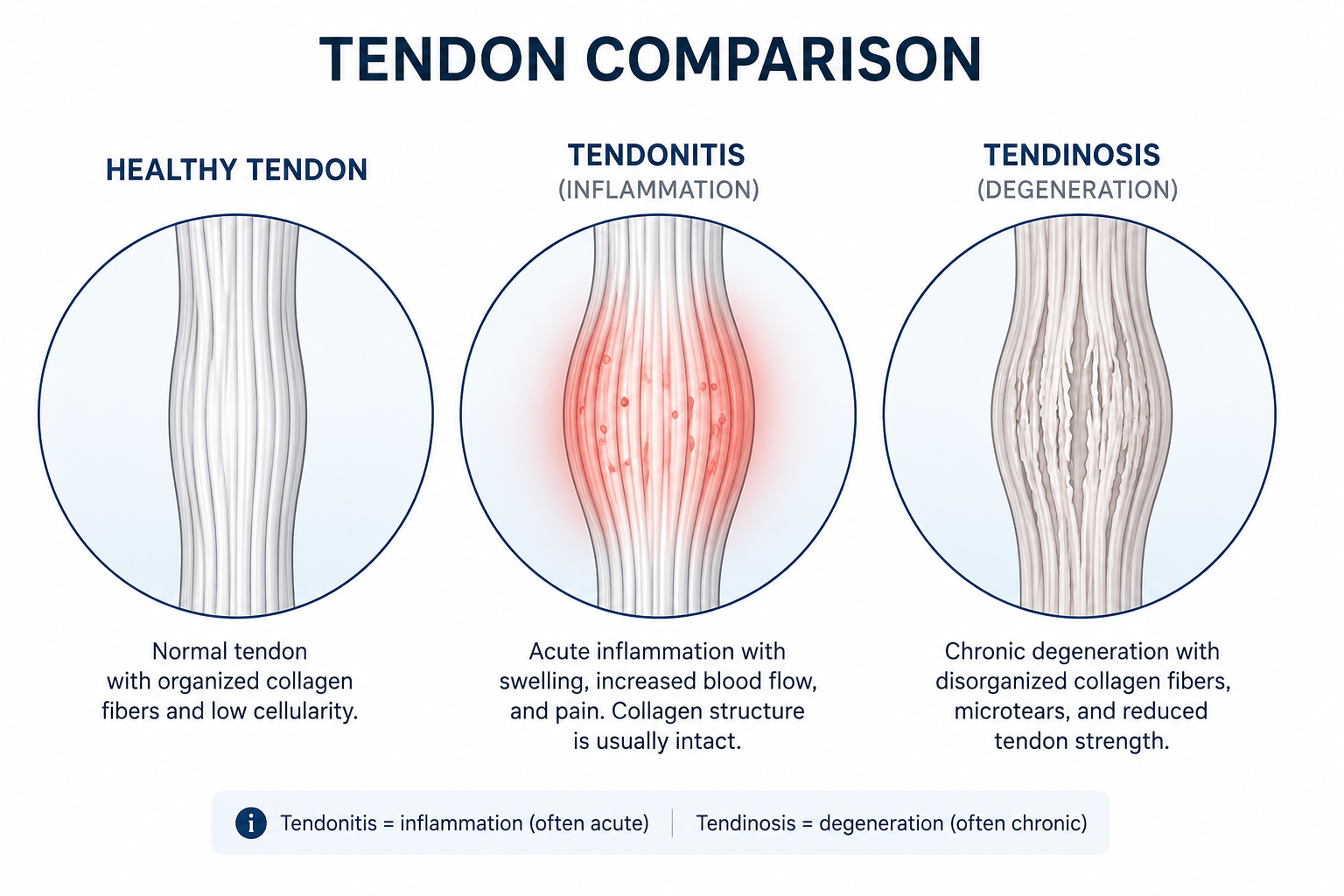
Many chronic tendon conditions once labeled "tendonitis" are now understood to involve degenerative changes (tendinosis), making regenerative therapies such as shockwave particularly relevant
Shockwave →
Cellular Signaling →
Increased Blood Flow →
Collagen Remodeling →
Reduced Pain →
Improved Function
Mechanical Effects
Shockwave therapy works through mechanotransduction—the conversion of mechanical energy into cellular signaling that stimulates tissue repair and remodeling.
Increased cell permeability – the shockwave stretches the outside of the cells, allowing nutrients to enter to speed up healing.
Simulates circulation – it promotes blood and lymph vessels speeding up nutrient delivery and waste removal.
Triggers the release of substance P, reducing pain signals and starting a controlled inflammatory response, promoting tissue repair.
Triggers the body to kill off abnormal nerve fibers (C-type) present in chronically inflamed tissues, decreasing long-standing hypersensitivity.
Stimulates nitric oxide, which enlarges blood vessels, speeds up local cell metabolism, and creates the formation of new blood vessels and leads to an anti-inflammatory effect.
Releases growth hormones (VEGF and TGF-β) critical for tissue repair
Stimulates stem cells enhancing tissue repair, particularly in chronic injuries
These biological effects help facilitate and support the body's natural tissue repair processes.
There are over 250 Peer-Reviewed sources for over 100 conditions. If the condition can be treated with a corticosteroid injection, it can be treated with shockwave but with no needles and better long-term outcomes.
Efficacy of extracorporeal shockwave therapy, compared to corticosteroid injections, on pain, plantar fascia thickness and foot function in patients with plantar fasciitis: A systematic review and meta-analysis. 2024 Clinical Rehabilitation. https://pubmed.ncbi.nlm.nih.gov/38738305/
Key findings:
At 3 months, shockwave was superior to corticosteroid injection for pain reduction and function.
At 6 months, shockwave maintained superiority for both pain and function.
Authors concluded that shockwave was more effective than corticosteroid injections at mid-term follow-up.
Clinical effects of extracorporeal shock-wave therapy and ultrasound-guided local corticosteroid injections for plantar fasciitis in adults: A meta-analysis of randomized controlled trials. 2018 Medicine (Baltimore)
https://pubmed.ncbi.nlm.nih.gov/30558080/
Key findings:
High-energy shockwave therapy produced greater pain reduction and higher success rates than steroid injection.
Low-energy shockwave was less impressive.
High-energy ESWT ranked as the best treatment among the compared interventions.
Comparison Between Extracorporeal Shock Wave Therapy and Local Corticosteroid Injection for Plantar Fasciitis. 2019 Foot and Ankle International https://pubmed.ncbi.nlm.nih.gov/31744313/
Key finding:
Both treatments improved pain and function, but the steroid group lost improvement over time, while the shockwave group maintained longer-lasting benefits.
Comparison of efficacy of shock-wave therapy versus corticosteroids in plantar fasciitis: a meta-analysis of randomized controlled trials. 2018 Archives of Orthopedic Trauma Surgery https://link.springer.com/article/10.1007/s00402-018-3071-1
Key finding:
Both shockwave and corticosteroid injection improved pain and function, but pain reduction favored shockwave.
Radial extracorporeal shock wave therapy is safe and effective in the treatment of chronic recalcitrant plantar fasciitis: results of a confirmatory randomized placebo-controlled multicenter study. 2008 American Journal of Sports Medicine https://pubmed.ncbi.nlm.nih.gov/18832341/
One of the landmark placebo-controlled studies demonstrating significant improvement in chronic plantar fasciitis.
Extracorporeal shock wave therapy is effective in treating chronic plantar fasciitis: a meta-analysis of RCTs 2013 Clinical Orthopdedics and Related Research https://pubmed.ncbi.nlm.nih.gov/23813184/
One of the most frequently cited Achilles shockwave studies.
Eccentric loading versus eccentric loading plus shock-wave treatment for midportion achilles tendinopathy: a randomized controlled trial. 2008 American Journal of Sports Medicine https://pubmed.ncbi.nlm.nih.gov/19088057/
Found consistent evidence that ESWT reduces pain and improves function.
The Effectiveness of Extracorporeal Shockwave Therapy for Midportion Achilles Tendinopathy: A Systematic Review. 2022 Cureus https://pubmed.ncbi.nlm.nih.gov/35989757/
Current evidence of extracorporeal shock wave therapy in chronic Achilles tendinopathy. 2015 International Journal of Surgery. https://pubmed.ncbi.nlm.nih.gov/26327530/
A Treatment Protocol for Achilles Tendinopathy with Extracorporeal Shockwave Therapy. 2024 Journal of Visualized Experiments. https://pubmed.ncbi.nlm.nih.gov/39158274/
Shockwave as a biological therapeutic tool. 2015 International journal of surgery https://pubmed.ncbi.nlm.nih.gov/26612525/
The role of mechanobiology in tendon healing. 2012 Journal of Shoulder and Elbow Surgery http://pubmed.ncbi.nlm.nih.gov/22244066/
Extracorporeal shock wave therapy mechanisms in musculoskeletal regenerative medicine. 2020 Journal of Clinical Orthopedic Trauma. https://pubmed.ncbi.nlm.nih.gov/32523286/
Best practices for extracorporeal shockwave therapy in musculoskeletal medicine: Clinical application and training consideration. 2022 PM&R. https://pubmed.ncbi.nlm.nih.gov/35187851/